






Sales enablement assets help sales teams close more deals.
This can involve enrolling your team members in training courses to fine-tune their skills, or giving them access to third-party articles and videos.
Many companies include sales battlecards among these resources and provide these assets to their sales reps to turn their buyer personas into fully-fledged customers.
What is a battlecard?
Battlecards are concise, actionable summaries of your product, the market, existing customers, and the competition, and their job is to equip your sales team with quick-fire responses to questions, queries, or objections a customer might have.
Sales battlecards typically live in your sales enablement platform, CRM, or as part of a larger sales playbook, making them easily accessible during calls or demos.
They also provide a firm understanding of a rival’s strategy and the value propositions needed to flag your offering as the preferable option.
Well-designed battlecards ensure reps are aligned on product positioning, can confidently differentiate your offering, and reinforce messaging consistency.
Looking to create sales battlecards? We've got you covered – download our battlecard template 👇
 James Shaw
Types of battlecards
Before you write a single line of content, decide who the battlecard is actually for. A battlecard built for a BDR handling a 30-second objection on a cold call needs completely different content from one built for an executive trying to understand a competitor's market position.
Most battlecards fall into four categories:
You don't need all four from day one. Most teams start with a Sales battlecard, since that's the version reps reach for most often, and build out BDR, Product, and Executive versions as the need for each becomes clear.
What to include in a sales battlecard
Your battlecard should be specific to your product, and include sections focusing on:
- Company/product overview
- Customer pain points
- Key features
- Key differentiators
- Why your product or service is the best on the market
- A script to handle customer objections
- Questions to ask the prospect
- Pricing
- Third-party validation
- Refer to relevant customers
These sections form the backbone of effective sales battlecards: one that arms your reps with contextual, relevant, and easily scannable information.
Let’s take a look at each feature in further detail:
Overview
The overview is a brief description of your company, your product, and what you're offering. Keep it punchy; 2-3 sentences is long enough.
Use real-world language your customer would use. Avoid jargon.
Customer pain points
This section should highlight the top 3–5 core challenges your target customers face – those that your product is uniquely positioned to solve.
These pain points should be specific, relevant, and framed using the customer’s own language wherever possible.
Avoid vague or generic issues like “lack of efficiency”; instead, dig into the real-world frustrations that cause prospects to seek a solution.
This should also capture both emotional and functional triggers behind a buying decision. For instance, a buyer might be motivated by a fear of making costly errors, frustration with slow manual processes, or pressure to meet KPIs.
Where relevant, emphasize the consequences of inaction to build urgency – what happens if the problem is ignored?
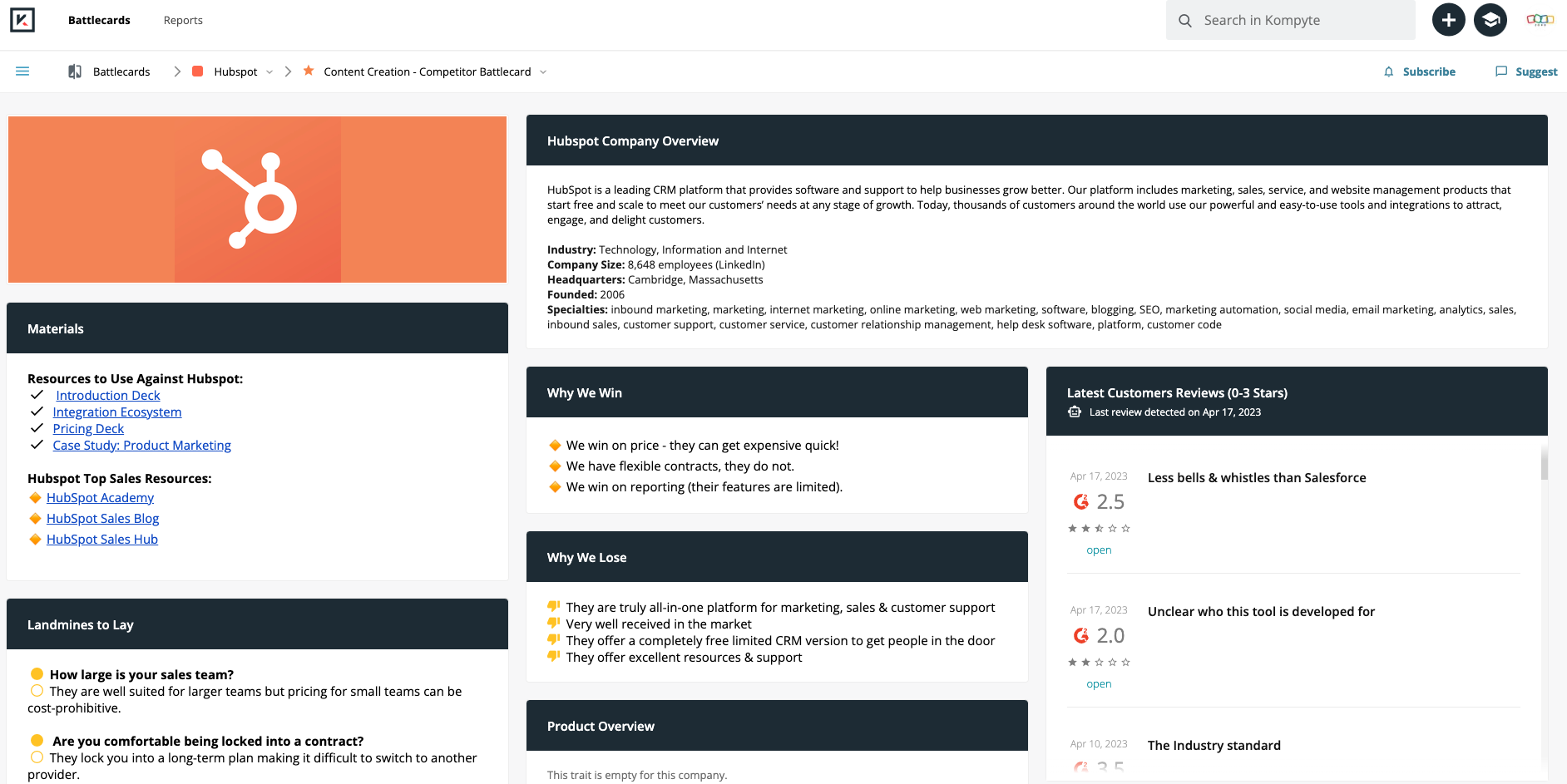
If you serve multiple personas or industries, tailor the pain points to match. A sales rep speaking to a CFO at an SMB will need different context than one speaking to a head of IT at a large enterprise.
Keeping this section sharp, scannable, and grounded in actual customer insights ensures reps can open conversations with empathy, relevance, and credibility.
Key features
After identifying your customer’s pain points, you need to demonstrate how your product addresses them.
Use bullet points or short phrases. Each feature should tie back to a problem.
Key differentiators
This is where you match your product up against your competitors.
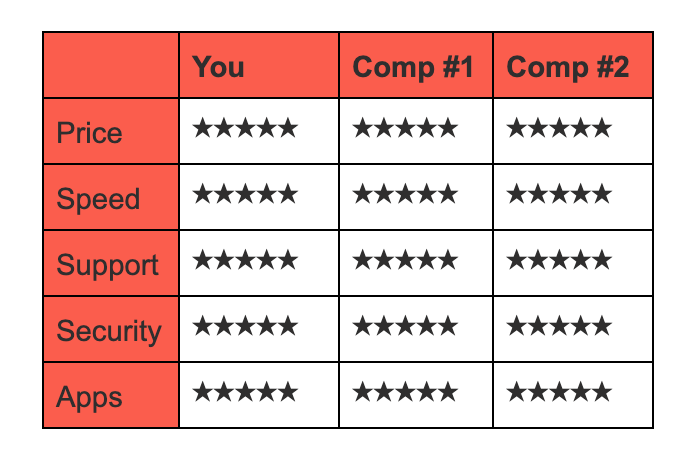
Reps need to quickly identify "what makes us better." A simple side-by-side table can work wonders here.
For example, if you’re offering a software solution, is your product more speedy? Does it have more features? Is your customer support better?
A handy grid format will help your sales team answer these questions quickly and confidently. 👇
Why do you win?
In this section, you’ll need to know what’s important to your potential customers.
For example, is it the price? Customer service? Security? If you don’t know this information already, conduct some customer and market research to give you a thorough understanding of your customers and what their needs are.
If you’ve conducted win/loss interviews or sales interviews, this is where the insights go.
List the relevant benefits your product provides and back it up with specifics. Use statistics, numbers, and real-life success stories.
Handling objections
Sometimes your sales team will face objections when pitching your product. You need to help them respond constructively and keep their pitch on track.
In this section, list your top three or four objections and script a response your sales team can refer to when they're met with these common obstacles.
Common objections might include: “You’re more expensive,” “We already use X,” or “We’re not ready to switch.”
Questions to ask
Here, list two or three questions your reps can ask the prospective customer to best position your product.
For example: “how do you feel about your current solution?” is a good starting point. This question allows your sales reps to differentiate your product from the competitors’.
Then, follow up with: “what’s the most frustrating thing about your current solution?” This question gives your reps insight into the prospect’s pain points and enables them to effectively position your product as the solution.
Also: "If you could wave a magic wand, what would change tomorrow?", which further gives your reps insight into the prospect’s pain points and enable them to effectively position your product as the solution.
Pricing
Product pricing will always play a crucial role in your customers' final buying decisions.
Rather than just stating your price, explain where your value lies. Include positioning like “all-in-one” or “no hidden fees” if applicable.
Ashley Murphy, Toast's Director of Market Insights and Pricing, shared her specialist insights, including her preferred pricing strategy, the role of product marketing in the pricing process, and her own top tips:
 Lawrence Chapman
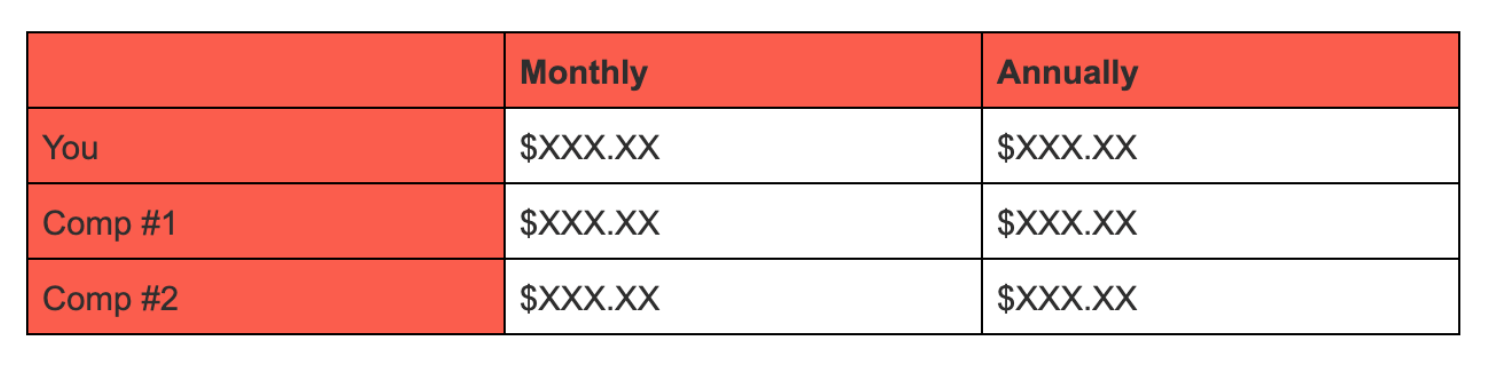
Your sales battlecards must include a section outlining your pricing, and how you match up against your main competitors. Make sure your sales reps have everything at their disposal to answer any questions about pricing accurately and confidently.
Update this section regularly – pricing changes are frequent and reps must always have the most up-to-date figures.
Tip: Conducting competitive intelligence will help you keep an eye on your competitors’ pricing and update your content, so your sales reps don’t provide out-of-date information.
Quick tips
Here’s where you need to make a few short notes about how your sales rep can get the most out of the call.
For example, it may be necessary to list a couple of questions you’d like your rep to ask:
- How many users they have
- Get a feel for their timeline to buy
- Confirm decision-makers are on the call
Third-party validation
Reputable customer testimonials or endorsements are priceless; they can give your product credibility and provide insight into what the prospect can expect if they decide to invest in your solution.
Prioritize logos or brands that resonate with the buyer’s industry, size, or region. Don’t overwhelm – one strong quote is better than five generic ones.
This section needs to shine the spotlight on what great things your existing customers are saying about you.
If a well-established, internationally recognized brand has provided a review, use their quotes.
This could include a comment a customer made about how much quicker they completed a task with your solution, in comparison to one of your competitors’ products.
 Charley Gale
Refer to relevant customers
Give your prospective customer FOMO by reeling off the companies you already have as customers. However, be sure to keep it relevant.
Match the prospect profile. If they’re a mid-size fintech, highlight other mid-size fintechs – not Fortune 500s.
For example, an SME will be more likely to relate to another SME over a Fortune 500 company.
The Fact, Impact, Act framework
Listing the sections your battlecard should include, as above, is only half the job. Without a consistent structure for each point inside those sections, battlecards turn into a wall of bullet points that reps skim past.
One widely used method for solving this is the Fact, Impact, Act framework (sometimes shortened to FIA), and it works on any of the sections covered above.
Each individual insight on your battlecard, whether it's a differentiator, an objection, or a pricing point, gets broken into three parts:
- Fact: the competitive insight itself, stated in one concise sentence. This is the “what.”
- Impact: why this fact matters, and when a rep should use it. This is the “so what.”
- Act: the specific action a rep should take: a talk track, a question to ask, or a next step. This is the “now what.”
Example card
Say your product has a simpler pricing model than a competitor's usage-based pricing.
Fact: [Competitor] charges based on usage, with fees that increase depending on volume and add-ons.
Impact: Buyers who've been burned by an unpredictable bill find this frustrating. That makes our flat, all-in pricing a strong fit for anyone who's told us cost predictability matters to their finance team.
Act: Ask the prospect: “How predictable has your current spend been month to month?” If they hesitate, walk them through our pricing calculator live on the call.
Applying this structure consistently across every section of your battlecard, not just pricing, gives reps a format they can learn once and then scan instantly, no matter which competitor or which card they're looking at.
Battlecard examples: a library of card types
The comparison grid earlier in this guide covers one common battlecard format, but it's worth building out a small library of card types rather than relying on a single generic layout. Here are five of the most useful to start with.
Why We Win
Your highest-value card. Lists the top three or four reasons customers choose you over a specific competitor, ideally backed by a real customer story or win/loss quote for each point.
Quick Dismiss
A short rebuttal reps can use the moment a competitor's name comes up in conversation, before the prospect has a chance to dwell on it. One or two sentences, no more: this card is about redirecting the conversation, not winning the argument on the spot.
Objection Handling
Scripted responses to the objections reps hear most often about a specific competitor: “they're cheaper,” “we already use them,” or “your product is missing X.” Pair each objection with a response your reps can adapt on the fly.
Pricing
A side-by-side of how your pricing compares, including where your value lies beyond the number itself (implementation costs, hidden fees, what's bundled in). This is the card that needs updating most often, since pricing changes faster than almost anything else on a battlecard.
Landmines
Two or three pointed questions reps can plant early in a competitive deal that quietly expose a gap in the competitor's product or approach, without your rep ever having to say a negative word about them directly.
Start with Why We Win and Quick Dismiss, since those two cover the situations reps encounter most often, then build out Objection Handling, Pricing, and Landmines as you gather more competitive intel.
Tips for creating sales battlecards
When planned and executed correctly, a battlecard can play a significant role in your sales success.
With this in mind, we asked product marketers for their tips on creating effective battlecards, and how they use them in their respective companies.
“I like to start with a SWOT for each competitor. I try honestly to assess their strengths, weaknesses, etc. I keep it pretty simple but I find it is a great starting point before building a battlecard.” – Martin Bakal, Principal Systems Modeler at MITRE
Firstly, consider your audience. How can you amplify the value of your research to cover not just sales processes, but product and leadership strategy?
You also need to include impacts to your go-to-market strategy and predictions for their future go-to-market strategy, customer segmentation, and product.
“Get in the weeds with pricing, packaging, and value delivery. Don’t just look at the perfect price point, but consider the value from your target customer’s perspective.
“Finally, include quotes where possible, and feedback from a customer that a) chose a competitor over you, and b) chose you over a competitor.” – Fiona Finn, Director of Product Marketing at jane.app
“Communicate internally and survey your sales team to understand who they're actually competing against and also pull in win/loss analysis to enhance your battlecard. Also, spell out how your company wins against each competitor so it's easy for sales to get what they need quickly.” – Jaclyn Rose, Staff Product Marketing Manager at HealthJoy
Why is sales enablement important?
You may be skeptical as to whether you need to create sales battlecards and accompanying sales enablement resources, especially if your sales figures are through the roof.
But ask yourself the following questions:
- Are you hitting ALL of your sales goals?
- Are your reps always on message?
- Are you 100% sure reps are using sales tools to their full potential?
- Can you improve seller quota attainment?
Sales enablement is not just about helping reps sell more, but also about helping them sell smarter.
If you’ve answered NO to any of these questions, or if you know there’s room for improvement, you need to devote time and effort to strengthening your sales enablement tools.
Even if you answer every question with a resounding YES, your business fortunes can quickly change.
For example, if you recruit new team members, you may need to formalize your onboarding process. Perhaps your reps have been tasked with selling an ever-changing product or service, in which case, the buying process could become more complicated, or your product messaging or go-to-market strategy may have to be revamped.
Having the appropriate sales enablement tools in place can work wonders for companies keen to maintain sales figures during a transition period.
Battlecards serve as a foundation for scalable, repeatable success, even when everything else is changing.
Still not 100% convinced? Take our sales enablement scorecard to see where you stand, and discover your biggest areas for improvement.
"You can have the best battlecard in the world. You can have the best competitive presentation in the world. But if your sales reps can't communicate it to a prospective customer, it means nothing. It means absolutely nothing. So our goal is helping sales reps understand and communicate." – Patrick Wall, Competitive Enablement Leader, Palo Alto Networks
Getting your battlecards adopted
A well-written battlecard that nobody opens isn't worth the time it took to build. Adoption comes down to one simple rule: put battlecards where your reps already spend their day, rather than expecting them to go looking for a document in a shared drive.
In Slack
Pin or bookmark battlecard links at the top of your team's key channels (a #competitive or #sales-chat channel works well), so a rep mid-conversation can find the right card in one click. If you're covering multiple competitors or roles, bookmark each version separately so reps land on the one that's actually relevant to them.
In Microsoft Teams
The same approach works in Teams: embed battlecard links directly into your channels or tabs, so reps have quick access regardless of which platform your organization runs day to day.
In your CRM (Salesforce or HubSpot)
This is where reps live during a live deal, so it's worth making battlecards accessible in two places: at the opportunity level, so a rep gets competitor-specific guidance the moment that competitor is logged against a deal, and on a general “Competitive” tab, for onboarding, pre-call research, and reps who just want a refresher.
Getting the placement right solves half the adoption problem. The other half is getting a few of your top-performing reps to visibly use the cards, reference them in team calls, and point peers to them in Slack when a competitor comes up. Role modeling from reps your team already respects does more for adoption than any announcement in an all-hands ever will.
How AI is changing battlecard creation
Battlecards used to be built the slow way: a product marketer manually researching a competitor, writing up findings, and saving a static document that started going stale the day it was published. By the time a rep needed it, the intel inside was often months old.
AI is changing that in two specific ways: how battlecards get created, and how current they stay.
Auto-generated content
Rather than starting from a blank template, AI tools can now pull from your existing intel, win/loss interviews, sales call recordings, competitor websites, review sites, to draft the core content of a battlecard automatically.
Klue's Compete Agent, for example, generates battlecards directly from a company's own knowledge base and call recordings, rather than generic information pulled from the open internet.
Crayon and Kompyte offer similar automated monitoring and generation, so the specific vendor matters less than making sure whichever tool you use is grounded in your own company's context rather than generic web data.
Auto-updating intel
The bigger shift is that battlecards no longer have to sit still between updates. Instead of a quarterly refresh, AI tools can monitor competitor websites, pricing pages, and news for changes continuously, and update the relevant card automatically.
Some platforms take this further: Klue's “Deal Tips” monitors live sales calls for competitive mentions and pushes relevant guidance straight to a rep's inbox mid-deal, rather than waiting for the rep to go looking for a card at all.
The speed benefit
The net effect is speed. Research from Klue puts daily AI usage among competitive intelligence teams at 60%, and the teams using it are spending less time on manual research and more time on the strategic side of the job: refining positioning, feeding insight back into product, and coaching reps on how to actually use what's in front of them.
AI won't replace the judgment behind a good battlecard, deciding what's actually relevant to a rep in a live deal still takes a human who understands the competitive landscape, but it's rapidly closing the gap between a competitor changing something and every rep's battlecard reflecting that.
Sales battlecard templates and frameworks
If you’re a PMA member, we’ve created a bank of editable templates and frameworks to help your sales team convert leads into customers.
Not a member already? Sign-up for a PMA membership to get access, and enroll in our Product Marketing: Core [On Demand] course, or Product Marketing: Core [Live + Online] accreditation to level up your strategy.


Product marketing insider
Thank you for subscribing
Level up your product marketing career & network with product marketing experts.
An email has been successfully sent to confirm your subscription.
 Follow us on LinkedIn
![How to create winning sales battlecards [+ examples]](https://storage.ghost.io/c/e8/42/e8425f10-c6bc-4266-b03f-495034377a60/content/images/size/w600/2026/09/sales-battlecards.png)


.svg)
Start the conversation
Become a member of Product Marketing Alliance to start commenting.
Sign up now